
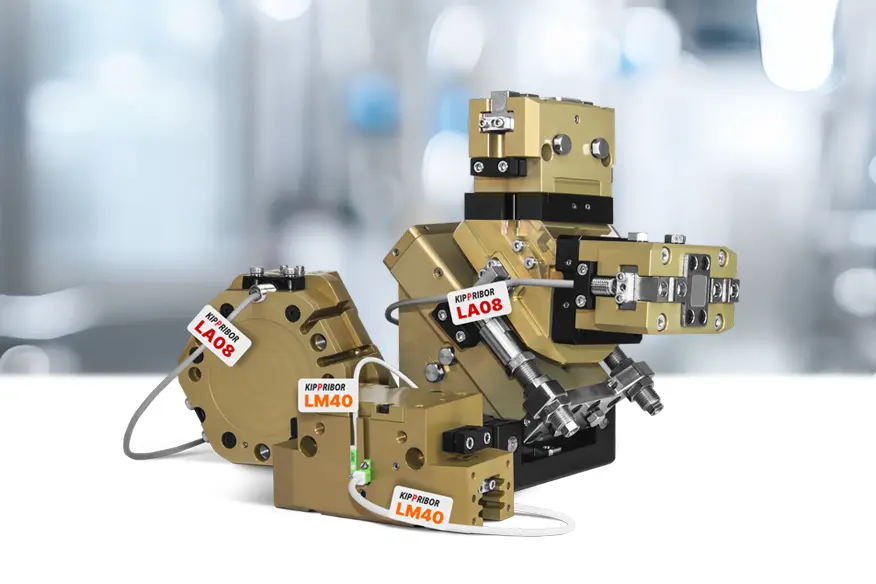
In automated manufacturing, not only the gripping mechanics or robot accuracy matter. Even a properly selected pneumatic gripper cannot operate reliably without position monitoring. Sensors allow the system to understand the current state of the equipment: whether the jaws are open or closed, whether the part has been gripped, whether the cycle is complete, and whether the system can proceed to the next operation.
In practice, the lack of position monitoring is one of the most common causes of unstable line operation. A robot may start moving with an incompletely clamped part, the workpiece may shift during transfer, and the machine may receive an incorrect signal that the cycle is complete. As a result, errors, downtime, and increased load on the equipment occur.
What Position Sensors Monitor
In a robotic production line, sensors are used not only to detect whether the jaws are open or closed. They are part of the logic of the entire system and help synchronize the operation of the robot, gripper, rotary mechanisms, and machine tool.
Most commonly, sensors monitor:
- jaw end positions;
- intermediate positions;
- part presence;
- rotary unit position;
- condition of the compensation module;
- correct completion of the operating cycle.
For example, the robot may receive a command to move the part only after confirmation that the gripper is fully closed. If there is no signal, the system stops the cycle until the issue is resolved. This helps prevent workpiece drops or equipment damage.
In automated production lines, these checks are performed continuously and are almost invisible to the operator, but they are exactly what ensures stable manufacturing operation.
Why the Risk of Errors Increases Without Sensors
In some projects, sensors are considered a secondary component, especially if the production line appears simple. However, in practice, even a minor deviation without monitoring can lead to serious consequences.
For example, when working with oily or smooth parts, the jaws may not close completely. Visually, the gripper appears operational, but the holding force is insufficient. If the robot starts moving without position confirmation, the part may shift or fall during the cycle.
This is especially critical:
- at high robot operating speeds;
- during automatic machine loading;
- when handling heavy workpieces;
- in multi-stage production lines;
- in systems with rotary units.
Another typical situation is part misalignment. Without monitoring, the system continues the cycle even though the workpiece is positioned incorrectly. As a result, the load on the gripper, tooling, and rotary mechanisms increases.
For such tasks, it is important to use not only a properly selected gripper, but also a position monitoring system capable of detecting deviations in time.
Inductive and Magnetic Sensors: What Is the Difference?
Inductive and magnetic position sensors are most commonly used in robotic systems. They solve similar tasks but operate according to different principles.
Inductive sensors react to the presence of a metal object within the sensing zone. Such solutions are well suited for monitoring end positions and offer high resistance to contamination and intensive operating conditions.
Magnetic sensors operate by detecting a magnetic field. They allow monitoring of both end and intermediate positions of system components.
The catalog of position control sensors includes solutions for pneumatic grippers, rotary units, and compensation modules used in automated production lines.
We recommend selecting the sensor type not only according to the wiring configuration, but also based on operating conditions: the presence of chips, vibrations, cycle intensity, and required monitoring accuracy.
Where Position Monitoring Is Especially Important
The more complex the automated system, the more important sensors become. In high-speed production lines, even a minor error can quickly result in production downtime.
Position monitoring is especially important:
- during automatic CNC machine loading;
- in robotic welding cells;
- on sorting and transfer lines;
- when handling long or heavy parts;
- in systems with multiple grippers;
- when using rotary units and misalignment compensation modules.
For example, if the robotic system uses rotary units, it is important to confirm that the rotation is complete before the next cycle stage begins. Otherwise, the risk of collision between the workpiece and tooling or incorrect positioning increases.
When working with unstable part positioning, it is also useful to use compensation modules, which help reduce system load and minimize the risk of misalignment.
How Sensors Affect Equipment Service Life
Position monitoring is required not only for cycle safety, but also for extending equipment service life. When the system detects errors in time, the probability of shock loads, misalignment, and emergency shutdowns decreases.
For example, if the jaws are not fully closed, the system will not allow the robot to continue the cycle. This helps prevent:
- damage to the part;
- gripper overload;
- impact on tooling;
- workpiece displacement;
- unexpected line stoppages.
In practice, a properly configured monitoring system makes equipment operation more predictable and stable even under intensive production conditions.
How to Select Sensors for Your Application
When selecting sensors, it is important to consider not only the sensor type, but also the entire system mechanics: gripper model, cycle speed, part type, and production conditions.
At FOUK KIPVALVE, we help select solutions for real automation tasks: robotic systems, automatic machine loading, transfer lines, and high-speed production systems. Depending on the operating conditions, it is possible to choose sensors for monitoring end or intermediate positions, as well as solutions for operation in harsh industrial environments.
Properly selected position sensors do more than simply monitor equipment — they make the entire robotic production line more stable, safer, and more accurate in daily operation.
Publication date: