
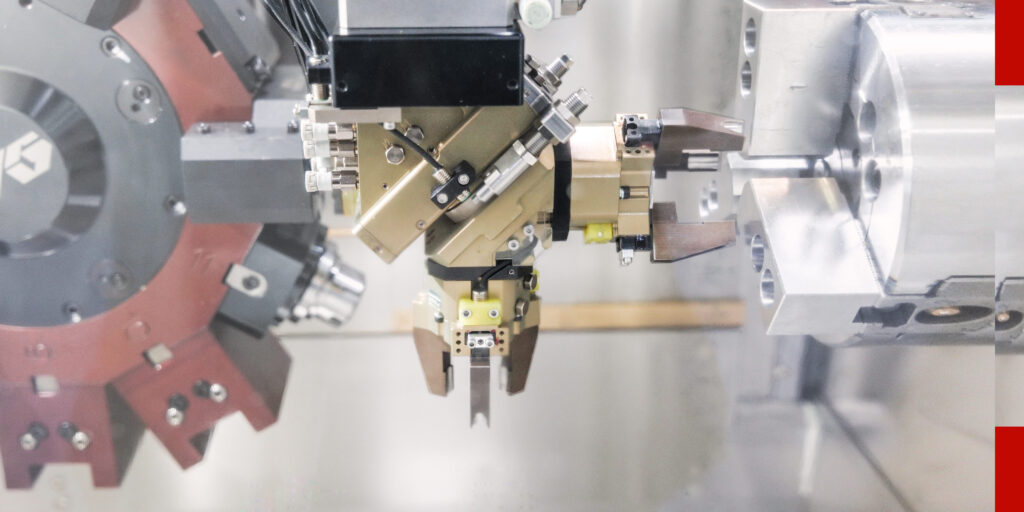
180° rotary units are used in automated systems where a part must be completely flipped during the production cycle. Such solutions are commonly applied in double-sided machining, robotic machine loading, part transfer systems, and automated production lines requiring a change in part orientation.
In practice, the most common mistake when selecting a rotary unit is calculating only based on the part weight. However, for stable operation, it is far more important to consider torque, workpiece length, and the position of the center of gravity. These parameters determine how reliably the system will operate during acceleration, braking, and rotation.
Why Part Weight Is Not the Main Parameter
Two parts with the same weight can create completely different loads on the rotary mechanism. For example, a short steel workpiece weighing 8 kg often places less stress on the system than a long aluminum part weighing 4 kg.
The reason lies in the distance between the center of gravity and the rotation axis. The farther the mass is offset, the higher the resulting torque. This effect becomes especially noticeable during rapid acceleration and braking of the robotic system.
In practice, it is important to consider:
- part weight;
- workpiece length and shape;
- center of gravity position;
- rotation speed;
- robot acceleration;
- part mounting method;
- type of installed gripper.
For example, a long pipe or profile creates significant inertial load even with relatively low weight. If this factor is ignored, the rotary unit starts operating under overload conditions: vibrations appear, positioning accuracy decreases, and the load on bearings and mounting elements increases.
How the Center of Gravity Affects System Performance
The ideal situation is when the center of gravity of the part is located as close as possible to the rotation axis. In this case, the load is distributed more evenly, and the system operates more stably.
However, in real production environments, this is rare. Many parts have an offset center of gravity:
- complex-shaped housings;
- welded structures;
- long workpieces;
- parts with uneven weight distribution;
- products with protruding elements.
If the center of gravity is shifted, additional leverage load occurs during rotation. This becomes especially noticeable at high operating speeds. Under such conditions, even a rotary unit correctly selected by weight may operate unstably.
We recommend evaluating not only the total part weight during the design stage, but also its behavior during rotation. In some cases, changing the gripping point provides a greater effect than installing a more powerful mechanism.
When a 180° Rotary Unit Is Required
180° rotation is used when a complete part flip is required during the production cycle.
Typical applications include:
- machining the second side of a workpiece;
- changing the working surface;
- automatic part reorientation;
- machine loading with double-sided machining;
- part flipping before assembly or packaging.
Unlike 90° systems, the mechanical loads here are usually higher because the part undergoes a full rotation cycle and has a greater impact on system balance.
In the catalog of rotary units, you can select solutions for operation with one or two grippers, as well as for various industrial automation scenarios.
Why the Gripper Type Matters
A rotary unit does not operate independently — it works together with a pneumatic gripper. Selection mistakes are also common here: the mechanism itself may be calculated correctly, but the gripper may not hold the part rigidly enough.
If the workpiece is long or has an offset center of gravity, the load on the jaws increases significantly during rotation. In such cases, it is important to consider:
- gripping force;
- guide type;
- number of fingers;
- structural rigidity;
- part position relative to the axis.
For high dynamic loads, more rigid gripping systems are usually preferred. For example, intensive production cycles with high acceleration often require solutions with toothed jaw synchronization.
Suitable pneumatic grippers can be selected based on part weight, cycle speed, and robotic system requirements.
Misalignment Compensation and Mechanical Protection
Even with precise robot operation, a part may arrive with slight positional deviations. If the system is rigidly fixed, such misalignments create additional load on the rotary unit and the gripper.
To reduce these loads, compensation modules are used. They help absorb misalignment and reduce the risk of impact loads during part installation.
This is especially important for:
- automatic machine loading;
- handling long workpieces;
- high-speed production cycles;
- systems using two grippers;
- high-precision part positioning.
In practice, a properly selected compensation module often significantly improves system stability without replacing the main equipment.
Typical Selection Mistakes
The following issues are most commonly encountered in production:
- selection based only on part weight;
- ignoring the center of gravity;
- insufficient torque reserve;
- excessive rotation speed;
- incorrect gripping point position;
- insufficient gripper rigidity;
- lack of misalignment compensation.
Another common mistake is trying to use one rotary unit for several parts with significantly different geometries. In such cases, the system often becomes unstable after increasing the production cycle speed.
How to Select the Right Solution for Production
A 180° rotary unit should be selected as part of the entire system: together with the gripper, robot, tooling, and operating conditions.
At FOUK KIPVALVE, we help consider not only part weight, but also real dynamic loads, center of gravity, workpiece length, and production line intensity. This approach makes it possible to select a solution that operates stably within an automated production system without overloading the mechanics or causing unnecessary downtime.
Publication date: