
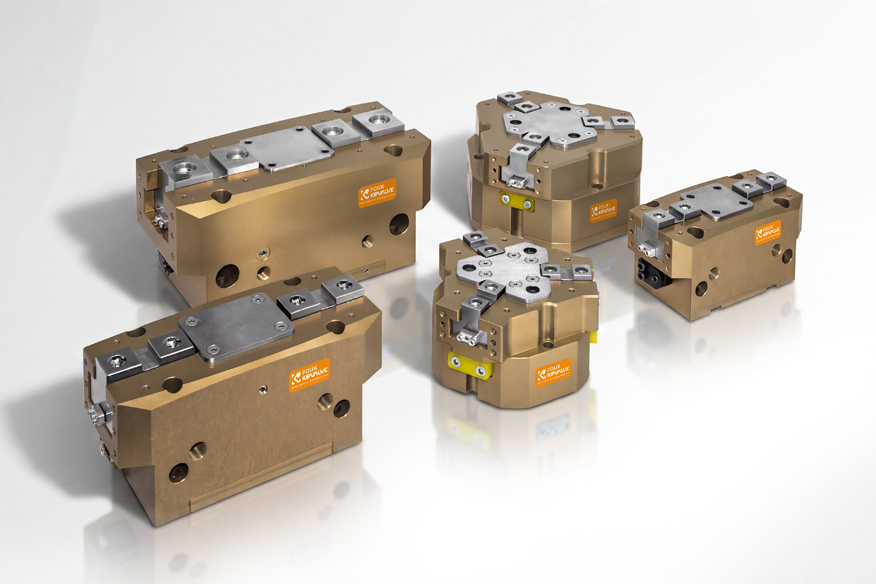
When selecting a pneumatic gripper for a robotic system, it is important to consider not only the weight of the part, but also how exactly it will be held during the operating cycle. In practice, workpieces with the same weight may require completely different solutions: one can be securely handled with a standard parallel gripper, while another may require a centering design with more rigid fixation.
The VGTR, VGFR, and VGFZ series are designed for different production tasks. The differences between them are related not only to guide construction or the number of fingers, but also to gripper behavior under load, robot operating speed, positioning accuracy, and part geometry. That is why the choice should be based not on the series name itself, but on the actual operating conditions.
VGTR: a versatile solution for standard applications
The VGTR series consists of parallel pneumatic grippers with a T-slot guide. These models are commonly used in automatic machine loading, robotic cells, transfer systems, and production lines where stable operation is required without complex part geometry.
The key advantage of VGTR is versatility and compact dimensions. These grippers are suitable for most standard tasks:
- handling flat or rectangular parts;
- automatic transfer of small workpieces;
- positioning parts into tooling;
- production lines with moderate cycle intensity.
For example, if a robot transfers metal plates, housings, or compact parts between machining stations, VGTR usually provides sufficient rigidity and stable holding force without excessive mechanical load.
These models are well suited for applications where compact size, moderate operating speed, and reliable gripping are important without requiring a complex centering system.
In our catalog of pneumatic grippers, you can select VGTR models with different gripping forces and jaw strokes for specific production tasks.
VGFR: when rigidity and high load capacity matter
The VGFR series visually resembles VGTR, but differs in guide construction. It uses gear synchronization of jaw movement, providing a more rigid mechanical structure and higher resistance to dynamic loads.
In practice, VGFR performs better:
- under high robot acceleration;
- in high-intensity production cycles;
- when handling heavier parts;
- in systems requiring high repeatability.
When a robot operates at high speed with rapid acceleration and braking, the load on the jaws and guides increases significantly. Under such conditions, a standard guide system may become less stable, especially when handling long parts or parts with an offset center of gravity. This is where the advantages of VGFR become most noticeable.
For example, during CNC machine loading with long metal workpieces, the VGFR series usually provides more stable gripping and is less susceptible to misalignment during sudden movement.
Another advantage is more reliable performance under intensive operation. If the production line runs multiple shifts with a high cycle rate, rigid jaw synchronization helps maintain positioning accuracy over long periods of time.
VGFZ: centering for round parts
The VGFZ series differs from VGTR and VGFR not only in design, but also in operating principle. These are three-finger centering grippers designed for round or cylindrical parts.
Such models are commonly used for:
- bushings;
- shafts;
- tubular components;
- cylindrical workpieces;
- rotational parts.
The main advantage of VGFZ is automatic centering of the part relative to the axis. This is especially important when the workpiece must be precisely fed into a chuck, tooling fixture, or process position after gripping.
For example, a parallel gripper may securely hold a cylindrical part, but the axial position will depend on jaw adjustment and part geometry. A three-finger system provides more stable centering and reduces the risk of displacement.
We recommend considering VGFZ whenever installation accuracy is critical or uniform gripping around the circumference is required.
How to consider gripping force
One of the most common mistakes is selecting a model based only on maximum part weight. In real production, the load depends not only on weight, but also on movement dynamics.
When selecting a gripper, it is important to consider:
- robot movement speed;
- acceleration and braking;
- part orientation;
- workpiece length;
- center of gravity;
- surface type;
- presence of oil or chips.
For example, a long aluminum part weighing 5 kg may create a higher load on the jaws than a compact steel workpiece weighing 8 kg. The reason lies in leverage and inertia during movement.
If the part surface is oily or smooth, additional gripping force margin is required. If the robot operates with a fast cycle, it is important to consider not only static holding force, but also dynamic loads during acceleration and braking.
Why sensors and compensation modules matter
Even a correctly selected gripper may operate unstably if the system does not account for part deviation or monitor jaw position.
Position sensors are used to monitor opening and closing. They help the system confirm cycle correctness and reduce the risk of errors in automated production lines.
If the part arrives with slight misalignment, it is useful to use compensation modules. They reduce jaw load and help prevent misalignment during part installation.
This is especially important for:
- automatic machine loading;
- handling long parts;
- high-speed production cycles;
- robotic systems requiring precise positioning.
How to choose the right series
If the application is universal and does not involve increased loads, the VGTR series is usually sufficient. For more intensive production lines and higher accelerations, VGFR is generally the better choice. If precise centering of round parts is required, VGFZ is often the most suitable solution.
In practice, however, the final selection always depends on the entire system: the robot, tooling, cycle speed, part type, and production conditions.
At FOUK KIPVALVE, we help select pneumatic grippers for real production applications: automatic loading, robotic systems, transfer lines, and CNC machinery. This approach helps reduce risks in advance and ensures stable operation within an automated system.
Publication date: