
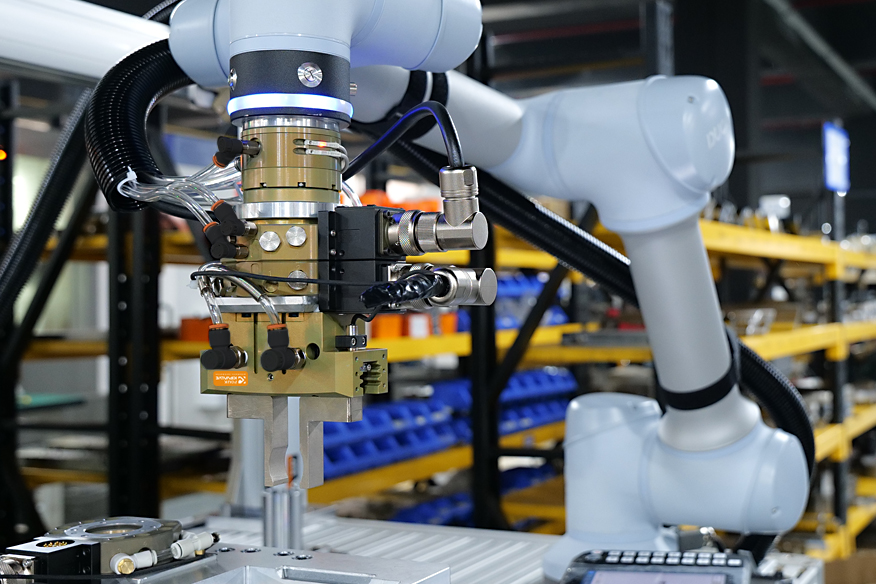
# Pneumatic Gripper for a Robot
A pneumatic gripper for a robot should not be selected based only on part size and payload capacity. In industrial automation, it operates as part of a complete system that includes the robot, tooling, pneumatic network, sensors, and the overall production cycle logic. If even one parameter is miscalculated, the system may start dropping parts, shifting them during positioning, damaging surfaces, or stopping the line due to control errors.
That is why the selection process should focus not on a single specification, but on the entire application: what type of part must be handled, how quickly it moves, in what position it is held, whether oil, chips, vibrations, pressure fluctuations, or precision requirements are involved. At FOUK KIPVALVE, we help select grippers based on real production conditions rather than just specification tables.
Where to Start When Choosing a Pneumatic Gripper
The first step is to define the part and the production cycle. It is important to consider not only the weight and dimensions, but also the shape, material, surface condition, center of gravity, and the position of the part during transfer. Parts with the same weight may require completely different solutions: a smooth cylinder is harder to hold than a part with flat surfaces, while thin-walled components cannot be clamped with excessive force.
Main parameters to evaluate before choosing a model:
- part weight, dimensions, and shape;
- material and surface condition: dry, wet, oily, rough;
- gripping method: external or internal;
- part orientation during transfer: horizontal, vertical, angled;
- robot movement speed and acceleration during start or braking;
- required positioning accuracy;
- presence of contamination, vibration, and pressure fluctuations in the pneumatic system.
For example, cylindrical parts often require self-centering to prevent shifting relative to the axis. Parallel gripping solutions are usually better for flat or rectangular parts. If the part is transferred vertically, the risk of slipping must be considered. If the surface is oily after machining, a higher gripping force reserve is required.
In the pneumatic gripper catalog, you can select models for different applications: automatic machine loading, robotic cells, workpiece handling, and processing parts of various shapes.
Gripping Force: Why Part Weight Alone Is Not Enough
A common mistake is selecting a gripper as if the part were held in a completely static position. In a real production cycle, the robot accelerates, brakes, changes trajectory, rotates the part, and may operate under vibration conditions. As a result, the actual load on the gripper jaws can be significantly higher than the static weight of the workpiece.
When calculating gripping force, it is important to consider part weight, holding direction, friction coefficient, robot acceleration, and a safety factor. The higher the cycle speed, the smoother the surface, and the more complex the motion path, the more carefully the selection should be made.
Insufficient gripping force can lead to part displacement or dropping. However, excessive force is also undesirable: it may leave marks on the surface, deform thin walls, or increase the load on tooling. The goal is not to choose the most powerful gripper, but to select a model with the correct safety margin for a specific application.
It is also important to consider working air pressure. If pressure drops occur in the pneumatic network, the gripper may operate unstably even when the model is selected correctly. In such cases, we recommend checking not only nominal pressure values, but also real operating conditions on the production line.
External and Internal Gripping: What to Consider
A pneumatic gripper can hold a part either externally or internally. External gripping is used when the jaws clamp the outer contour of the part. Internal gripping is used when the gripper expands inside a hole, bushing, or cavity.
External gripping is commonly used for housings, blanks, plates, and parts with flat or cylindrical surfaces. Internal gripping is suitable for bushings, rings, tubular components, and parts with технологических holes. However, wall thickness, allowable load, and deformation risk must be considered.
If the part has non-standard geometry, not only the gripper itself matters, but also the jaw design. Tooling should match the working surface of the part or securely hold it at the correct points. In some cases, properly designed jaws provide a greater improvement than replacing the gripper with a more powerful model.
The Role of Sensors and Misalignment Compensation
In an automated system, it is important not only to grip the part, but also to confirm that the gripping operation was completed correctly. This is why position sensors are used. They allow the system to determine whether the jaws are open or closed, whether the required position has been reached, and whether a cycle error has occurred.
If the robot picks a part from a storage system, machine tool, or conveyor, small positioning deviations are almost unavoidable. Without compensation, these deviations may create additional stress on the gripper, jaws, mounting system, and the robot itself. For such applications, compensation modules are used to absorb misalignment and reduce the risk of equipment damage.
To monitor end and intermediate positions, position control sensors can be used. This is especially important in production lines where a single cycle error may stop an entire section or lead to defective products.
Typical Mistakes When Choosing a Robot Gripper
In practice, problems are more often caused not by equipment quality, but by incomplete technical specifications. For example, the part weight is considered, but robot acceleration is ignored. Or gripping force is selected correctly, but the oily surface of the part is overlooked. Another common issue is using one universal model for several different parts with completely different geometry and holding points.
Typical mistakes also include:
- selection without considering working pressure and possible pressure drops in the pneumatic system;
- lack of gripping force reserve for high-speed cycles;
- incorrect jaw geometry;
- ignoring the part’s center of gravity;
- absence of position sensors;
- operation without misalignment compensation where parts arrive with deviations;
- attempting to use one gripper for completely different products.
To avoid these problems, we recommend describing not only the part itself, but the entire production cycle in advance: where the robot picks the part, where it places it, how fast it moves, and what types of errors are unacceptable for the production process.
How FOUK KIPVALVE Helps Select the Right Solution
When selecting equipment, we analyze the application as a whole: part type, weight, jaw stroke, gripping force, holding method, environmental conditions, precision requirements, and the need for additional modules. In some cases, selecting the right pneumatic gripper is enough. In others, it is better to immediately include a compensation module, position sensors, or a special jaw design.
Our catalog includes solutions for robotic systems, automatic machine loading and unloading, workpiece handling, and integration into industrial production lines. This approach helps reduce implementation risks and achieve more stable equipment operation.
A pneumatic gripper for a robot is not a secondary component, but one of the key elements of the entire automated cell. When selected correctly, the robot works more accurately, the production cycle becomes more stable, and the manufacturing process depends less on manual adjustments. That is why it is important to evaluate not only the model itself, but also the specific application it is intended to solve.
Publication date: