
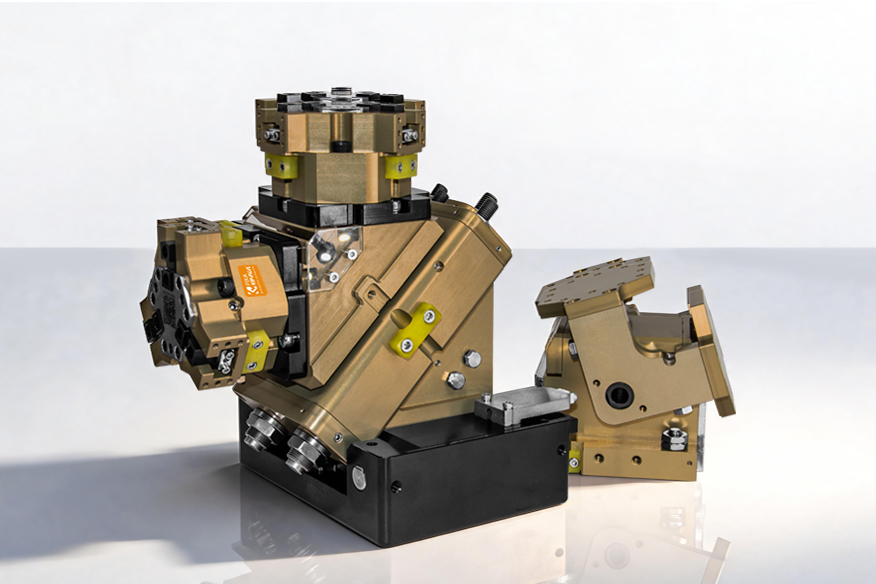
In automated production lines, a rotary unit does much more than simply change the position of a part. It directly affects machine loading stability, positioning accuracy, cycle speed, and the load placed on the robotic system. That is why selecting the right solution requires considering not only the rotation angle, but also the actual mechanics of the process: part weight, center of gravity, robot acceleration, and operating conditions.
In practice, mistakes in rotary unit selection often do not appear immediately. At first, the line may operate normally, but as cycle speed increases, issues such as misalignment, tooling impacts, positioning errors, or unstable gripping begin to appear. For this reason, it is important to understand from the design stage what type of rotation the production process requires and what loads the system will experience.
When to Use 90° Rotation and When 180° Is Required
90° and 180° rotary units solve different production tasks. A common mistake is choosing equipment “with extra margin,” even when the actual production cycle does not require a full part rotation.
90° rotation is typically used:
- to change the orientation of a workpiece;
- to feed a part into a machine tool;
- for transfer between a conveyor and a robot;
- to position a part into its working orientation.
These systems usually operate faster and place less stress on the mechanical assembly.
180° rotation is used in more complex scenarios:
- when a part must be completely flipped;
- for machining the second side;
- to change the working surface;
- in automated cells with dual-side processing.
For example, if a workpiece enters a machine horizontally and must be flipped after machining for a second operation, a 180° rotary mechanism simplifies the process and eliminates the need for additional mechanical systems.
We recommend selecting the rotation angle based not on versatility, but on the actual production process. This helps reduce system load and avoid unnecessary mechanical complexity.
Why Part Weight Is Not the Only Important Factor
One of the most common mistakes is selecting a rotary unit based only on workpiece weight. In real operation, the load depends not only on weight, but also on part geometry.
For example, a long aluminum workpiece weighing 4 kg may create a higher load than a compact steel part weighing 8 kg. The reason lies in lever length and center-of-gravity offset. During rotation, an additional torque load acts on the mechanism.
When selecting a rotary unit, it is important to consider:
- part weight;
- workpiece length and shape;
- center-of-gravity position;
- rotation speed;
- robot acceleration and braking;
- production cycle intensity;
- vibration and impact loads.
This becomes especially critical in high-speed production lines. The higher the robot speed, the greater the dynamic load on the rotary mechanism. Therefore, the load reserve must be calculated based on real operating conditions, not only on the nominal part weight.
In the FOUK KIPVALVE rotary units catalog, it is possible to select solutions both for compact parts and for heavier or long workpieces used in automated production lines.
One Gripper or Two: What to Consider
Rotary units can operate with either one pneumatic gripper or two simultaneously. This directly affects load distribution and overall system stability.
A single-gripper setup is usually simpler and more compact. It works well for small parts and standard transfer operations. However, if the workpiece is long or has an offset center of gravity, one gripper may not provide stable handling.
A dual-gripper system is used:
- for handling long workpieces;
- for heavier parts;
- at high transfer speeds;
- when stable positioning during rotation is critical.
In these cases, the load is distributed more evenly and the risk of misalignment is reduced.
Why Misalignment Compensation Matters
Even with accurate robot operation, a part does not always arrive in exactly the same position. Small deviations create additional stress on the rotary unit, gripper jaws, and mounting assembly.
To reduce these loads, compensation modules are used. They help absorb misalignment and reduce the risk of equipment damage during automatic machine loading and robotic operation.
Compensation is especially important:
- when handling long parts;
- in high-speed production lines;
- during automatic CNC machine loading;
- in systems where workpieces may arrive slightly offset.
In practice, a properly selected compensation module often provides a greater improvement than simply increasing the rigidity of the entire system.
Position Monitoring and Cycle Stability
For stable operation of an automated production line, it is important to monitor the mechanism position during every cycle. If the system does not receive confirmation of the rotary unit or gripper position, the risk of errors and equipment stoppages increases.
For this purpose, position sensors are used. They help monitor system status and improve the reliability of the automated cycle.
This is especially important:
- during high-speed operation;
- in robotic systems;
- when integrated with CNC machines;
- in continuous production lines.
How to Select the Right Solution for Production
A rotary unit should never be considered separately from the rest of the system. The selection process must take into account the gripper type, robot parameters, part geometry, and the overall production process.
At FOUK KIPVALVE, we help select solutions for specific applications: automatic machine loading, robotic cells, production lines, and part transfer systems. In some cases, a compact 90° rotary unit is sufficient, while other applications require a 180° system with consideration for center of gravity, misalignment compensation, and high cycle intensity.
A properly selected rotary unit improves cycle stability, reduces equipment load, and increases the accuracy of the entire automated system.
Publication date: