
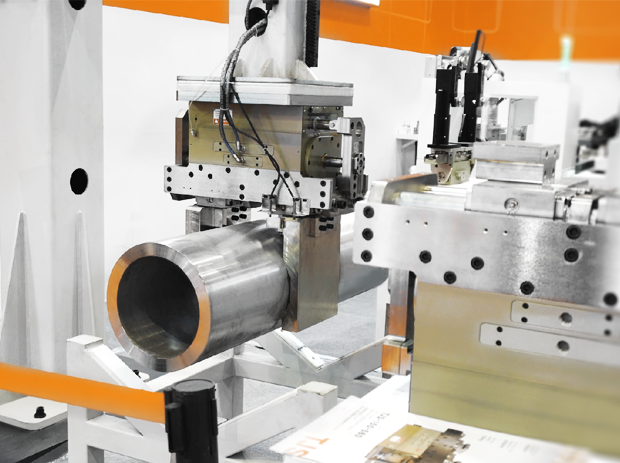
A pneumatic gripper for a heavy workpiece should not be selected based on a single parameter such as “part weight”. For reliable operation, it is necessary to evaluate the gripping method, force at the contact point, length of the gripper fingers, position of the center of gravity, acceleration of the robot or gantry, and the load during acceleration, braking and part rotation.
If the gripper is selected only by weight, the workpiece may shift, slip or create an excessive moment load on the jaws, guides and robot wrist during the actual cycle. This is especially critical when loading CNC machines, handling metal structures, hubs, welded frames, cast parts and other products with a large overhang or an offset center of gravity.
For heavy-duty applications, KIPVALVE offers reinforced two-finger parallel pneumatic grippers of the VGTJ series. Depending on the model, the series provides a single-finger stroke from 100 to 125 mm, a gripping force of over 10,000 N, and can be used for workpieces weighing up to 800 kg, provided that the conditions of the specific version and the calculated gripping scheme are observed.
Why a gripper should not be selected only by workpiece weight
The maximum part weight specified in the model characteristics is a reference value for defined gripping conditions. It does not take into account all the specifics of a particular robotic cell.
The actual load is affected by:
- the position of the workpiece center of gravity;
- the length of the gripper fingers and the part overhang;
- the material and surface condition;
- the presence of oil, cutting fluid, dust or scale;
- the gripping method: frictional or form-fit;
- robot acceleration and braking;
- the orientation of the part during movement;
- the frequency of working cycles;
- the weight of the adapter plate, fingers, sensors and additional tooling;
- the need to rotate the part.
For example, a 100 kg workpiece with its center of gravity positioned far from the gripping area can create a greater moment load than a heavier but more compact part. Therefore, during selection it is necessary to calculate not only the vertical holding force, but also the permissible moments on the jaws and gripper body.
Our engineering manual states that excessively long and heavy fingers increase inertia during opening and closing, reduce the permissible load capacity of the gripper and shorten the service life of the equipment.
First, define the gripping method
Frictional gripping
With frictional gripping, the part is held by the friction force between the gripper fingers and its surface. This option requires a force reserve, especially when working with smooth, oily or coolant-covered parts.
Frictional gripping can be used for flat, cylindrical, housing-type and profile workpieces, provided that the gripper fingers have the appropriate shape and sufficient contact area.
Form-fit gripping
With form-fit gripping, the fingers rest against a shoulder, groove, protrusion, hole or another design feature of the part. This solution is often more reliable for heavy workpieces, because the load is supported not only by friction.
For large-sized products, welded frames, trusses, hubs and parts with complex profiles, form-fit gripping is usually preferable. It reduces the risk of workpiece displacement during acceleration, rotation or emergency stop.
How to choose the type of pneumatic gripper for a heavy workpiece
Reinforced VGFR models
VGFR series parallel pneumatic grippers are suitable for tasks with increased loads where a compact design, synchronized movement of two jaws and the ability to work with longer gripper fingers are required.
The series uses a multi-tooth guide. According to its technical characteristics, this design is intended for higher load capacity, reduces backlash and helps maintain movement accuracy under load compared with a classic T-slot guide.
VGFR should be considered for medium-weight metal parts, machine loading and unloading, handling housings, workpieces, bushings, profile products and parts that are gripped by two opposite surfaces.
Heavy-duty VGTJ pneumatic grippers
The VGTJ series is designed for heavy and large-sized workpieces. These are two-finger parallel grippers with a chrome-plated shaft and sliding bearings. They are used in automated lines, for handling metal structures, hubs, frames and other products that require a long stroke and high gripping force.
The VGTJ series includes the following models:
- VGTJL70-250 — a long-stroke version that is specified in the technical manual as a solution for gripping hubs and other products;
- VGTJM115-530 — a reinforced gripper with two cylinders, rack synchronization and the option of mechanical self-locking;
- VGTJS150-580 — a model for the heaviest applications, also with two cylinders, rack synchronization and the option of self-locking.
At the same time, the series should not be described or perceived as a universal solution “for parts up to 800 kg”. The permissible weight always depends on the design of the fingers, the position of the center of gravity, the coefficient of friction, the direction of movement, the cycle speed and the gripping method.
How finger length affects gripper selection
Gripper fingers determine the actual force in the contact area with the part. The greater the finger overhang, the higher the load on the jaws and guides.
If the fingers are too long, the following risks arise:
- reduced force at the contact point;
- increased bending moment;
- vibrations during acceleration;
- reduced repeatability;
- deformation of the body or guides;
- shorter gripper service life.
If the required finger length exceeds the permissible range for the selected model, it is better to choose a larger gripper size rather than compensate for the problem by increasing pressure. If the permissible finger length is exceeded, we recommend selecting a gripper one size larger.
Center of gravity and moment of inertia: key parameters for heavy parts
For a heavy part, it is necessary to assess not only its weight, but also the location of its center of gravity relative to the gripper mounting point and the robot wrist.
The farther the center of gravity is offset:
- the higher the load on the guides and body;
- the greater the moment on the robot flange;
- the more difficult it is to ensure stability during acceleration and braking;
- the higher the risk of part displacement during rotation;
- the greater the requirements for the rigidity of adapter plates and fingers.
The gripping unit must be calculated especially carefully if the part is long, asymmetrical, has a cantilevered overhang or is moved in a vertical position. The robot manufacturer also defines load limits for the wrist, so the total weight of the gripper, fingers, adapter plate and part must be checked together with the position of the center of gravity.
When mechanical self-locking is required
For heavy parts, it is necessary to determine in advance what should happen in the event of an air pressure drop or emergency stop of the equipment.
Versions with mechanical self-locking can maintain the set gripper position when pressure drops:
- NC — maintains the closed position;
- NO — maintains the open position.
Self-locking can improve the stability of the clamping action, but it does not replace the design of the overall safety system. For a heavy workpiece, it is important to assess the risk of dropping, the robot movement path, personnel access to the working area and equipment behavior after restart.
Is a rotary unit required for a heavy part?
A rotary unit is required if the workpiece needs to be reoriented, turned before being fed into the machine, or if loading and unloading need to be combined in one cycle.
In this case, the entire unit must be calculated:
- gripper weight;
- finger weight;
- part weight;
- tooling overhang;
- moment of inertia;
- rotary unit torque;
- braking energy;
- mounting rigidity.
For heavy parts, it is not enough to rely only on the built-in buffer of the rotary unit. With a large workpiece mass, it is recommended to provide an external buffer device to absorb impact force and separately evaluate the rigidity of the mechanical structure.
What data is needed to select a heavy-duty pneumatic gripper
To select a gripper for a heavy workpiece without errors, prepare the following:
- a drawing or 3D model of the part;
- weight and overall dimensions;
- material and surface condition;
- dimensions of the gripping area;
- position of the center of gravity;
- gripping method: frictional or form-fit;
- required direction of movement;
- acceleration and cycle time;
- data on the robot, gantry or manipulator;
- the need for rotation, compensation or self-locking;
- temperature, contamination level and other working area conditions.
For critical operations, it is also recommended to provide position monitoring sensors. For the VGTJ series, two KIPPRIBOR LA08 inductive sensors can be installed.
Selection of a gripping unit for a heavy part
A pneumatic gripper for heavy parts is part of a system, not a standalone element. Reliability depends on the correct combination:
gripper + gripper fingers + adapter plate + sensors + air preparation + rotary or compensation module, if required.
The gripper requires clean compressed air for operation. Moisture, oil and dust can cause wear, corrosion, jamming of moving elements and unstable equipment operation.
Send us a drawing or 3D model of the workpiece, and our KIPVALVE specialists will help select a pneumatic gripper for heavy parts, gripper fingers, sensors, a rotary unit and pneumatic system components for your specific production cycle.
Frequently Asked Questions
Which pneumatic gripper should be selected for a part weighing more than 100 kg?
Selection should not begin with weight alone, but with an analysis of geometry, center of gravity, gripping method, finger length and direction of movement. For heavy-duty tasks, VGTJ heavy-duty parallel grippers can be considered, but the specific model must be selected after checking the load and cycle conditions.
Can the load capacity of a gripper be increased by air pressure?
Only within the limits allowed for the specific model. Increasing pressure does not compensate for excessive finger overhang, weak tooling design or an offset center of gravity of the part.
When is form-fit gripping required?
It is required when the part has a shoulder, groove, hole, protrusion or another contour that the fingers can reliably rest against. For heavy parts, this is often safer than gripping based only on friction.
Why are position sensors needed for a heavy part?
Sensors help monitor whether the gripper has fully opened or closed and whether the part has not been lost before the next action starts. This is especially important when loading CNC machines, rotating the unit and automatically transferring parts between positions.
Publication date: