Which gripper should I choose for round workpieces?
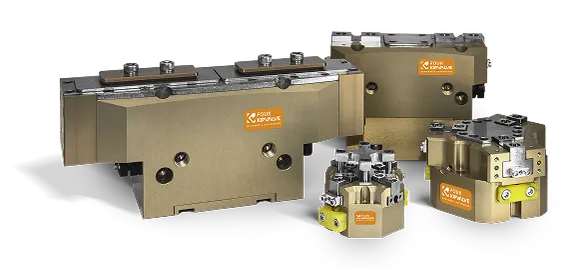
For reliable grip of round workpieces (shafts, tubes, rods) from the end, three-finger centric grippers of the VGTZ and VGFZ series are recommended. They apply uniform force from all sides, preventing part deformation and slippage.
The VGTZ series is suitable for standard applications, while the VGFZ series — with a reinforced toothed guide — is designed for heavier-duty operation and higher loads.
Can the grippers be used in vibration or shock environment?
FOUK&KIPVALVE grippers are designed to operate in standard industrial environment. However, in case of significant vibration or shock prone, it is recommended:
— to use grippers with mechanical self-locking (NO/NC versions);
— to install external buffer devices;
— to shorten the length of the fingers to reduce inertia.
How can monitoring sensors be integrated into the gripping system?
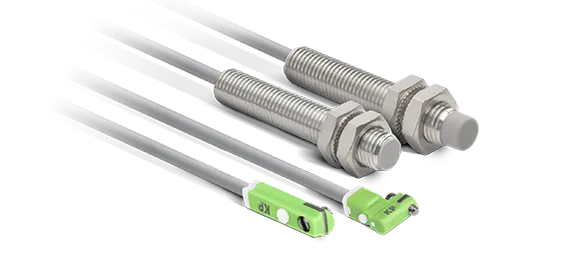
Most FOUK&KIPVALVE grippers have built-in slots for position monitoring sensors. It is recommended to use inductive sensors of the KIPPRIBOR LA08 series or magnetic sensors of the KIPPRIBOR LM40 series.
For example:
— 2 sensors can be installed on VGTR and VGFR series grippers;
— 3 sensors – on three-finger VGTZ series grippers;
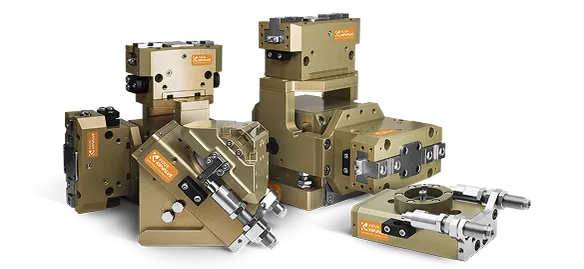
— 2 sensors – on VRTG/VRTE rotary blocks.
The sensors allow to monitor the gripper condition and detect failures in automatic mode.
What safety measures should be taken when using pneumatic grippers?
It is important to take the following safety measures when working with FOUK&KIPVALVE pneumatic grippers:
1. Standby retention: for critical applications, use mechanically interlocked (NO/NC) grippers that maintain gripping position when pressure drops.
2. Fall Protection: always design additional mechanical safety devices in case of an emergency air or power outage.
3. Buffer elements: when working with heavy workpieces, install external buffers to dampen inertial loads.
4. Motion areas: protect the work envelope of the gripper to avoid injury to personnel.
5. Clean air: be sure to use filters and dehumidifiers for the supplied air — this will prevent wear and jamming.
How to correctly select the finger length for a gripper?
The finger length directly affects the gripper's reliability and durability:
Short fingers are preferable for high-speed operations — they reduce inertia and increase accuracy.
Long fingers are required for handling large parts, but their mass must not exceed the values specified in the gripper's technical specifications.
Clamping force decreases as the finger length increases. Always check the force vs. length graphs in the manual.
Center of Mass: A shift in the center of gravity can lead to actuator overload or reduced positioning accuracy.
We recommend using the calculation graphs and CAD models of the grippers for precise selection.
What are compensation units and when are they needed?
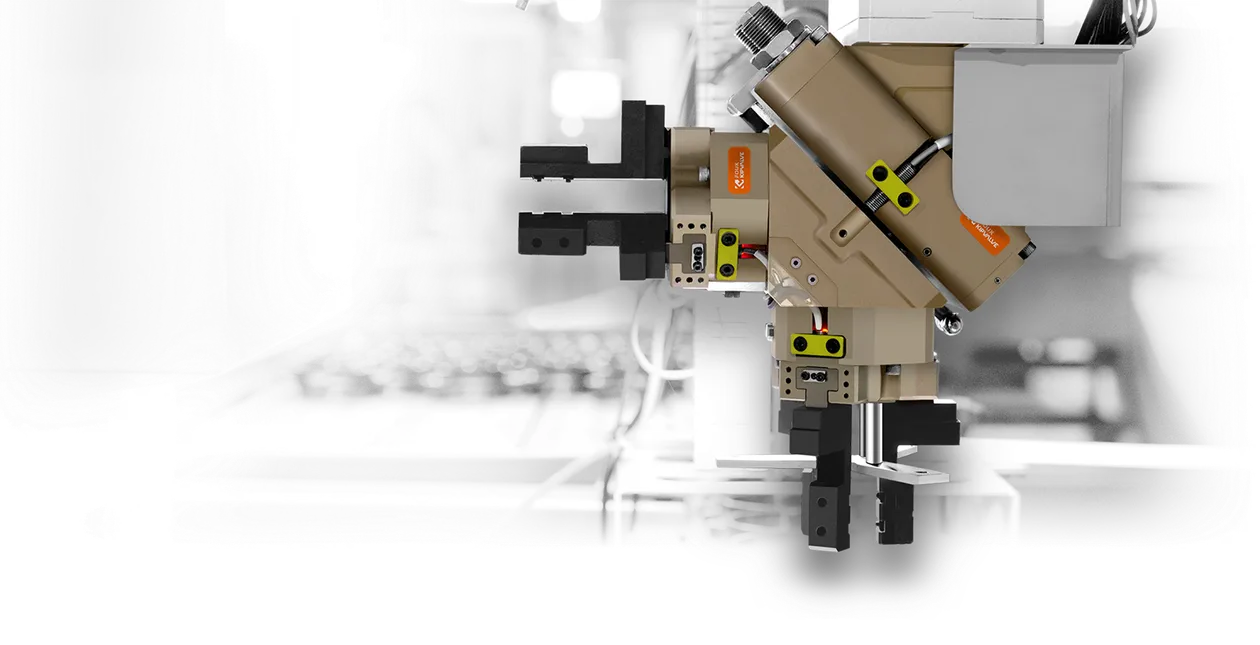
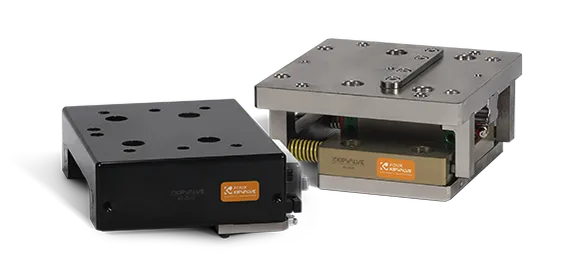
HT-ZG and HT-HE series compensation units are modules installed between the gripper and the rotary device (VRTG/VRTE). They serve two main purposes:
Compensation for inaccuracies: They allow the gripper to adjust to parts with dimensional tolerances or slight misalignments.
Collision protection: If an incorrect part is fed or an accidental impact occurs, the unit absorbs the load, preventing damage to the gripper or robot.
Signaling: They are equipped with inductive sensors (KIPPRIBOR LA08 series inductive sensors are recommended) that detect activation and can stop the cycle.
They are primarily used in CNC machines, robotic loading/unloading, and the assembly of precision units.